> For the complete documentation index, see [llms.txt](https://developer.emporix.io/llms.txt). Markdown versions of documentation pages are available by appending `.md` to page URLs; this page is available as [Markdown](https://developer.emporix.io/frontend-guides/customer-account/dashboard-overview.md). Agents can also search and read this documentation through its [MCP server](https://developer.emporix.io/~gitbook/mcp).
# Dashboard
Get an overview of the Emporix Commerce Frontend user dashboard, including widgets, notifications, and navigation menu sections.
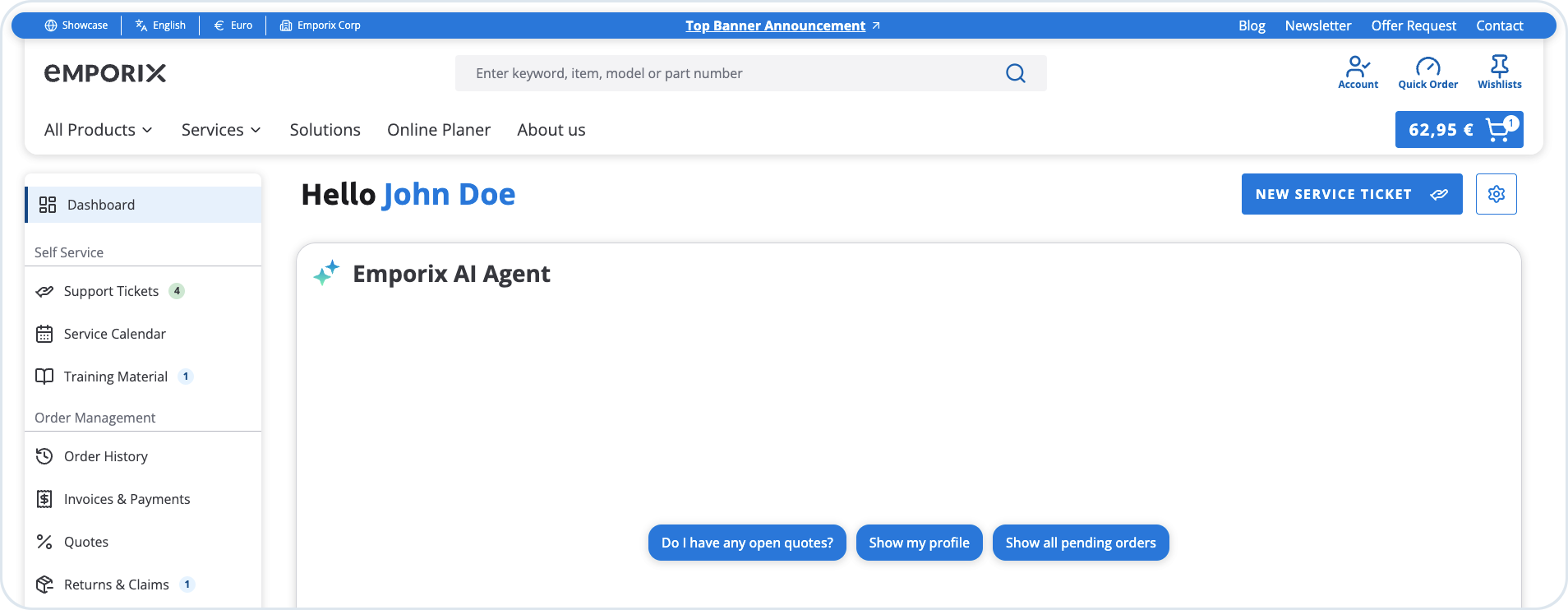
The Dashboard acts as the overview page of the account area. It summarizes recent activity and provides quick entry points to important account actions.
From here, customers can quickly view their most recent orders, pending quotes, saved wishlist items, or approval requests, depending on the business configuration. The dashboard is designed to help users immediately understand the status of their purchasing activities and navigate directly to relevant sections without browsing through the full account menu.
At the top of the dashboard, you have quick access to the Frontend Agent for questions about your account, creating returns and others.
The top bar also includes actions for **site**, **language**, and **currency** selection, so users can quickly adjust their shopping context.
User dashboard with widgets, notifications, and navigation menu
## Company switcher
If a customer is assigned to more than one company (legal entity), a **company switcher** appears in the top bar so they can select the organization they are acting on behalf of. Company-specific account views use permissions for that selected company.
The following account areas are company-specific:
* [Order History](https://developer.emporix.io/frontend-guides/customer-account/dashboard-overview/order-history.md)
* [Returns and Claims](https://developer.emporix.io/frontend-guides/customer-account/dashboard-overview/returns-and-claims.md)
* [Approvals](https://developer.emporix.io/frontend-guides/customer-account/dashboard-overview/approvals.md)
* [Quotes](https://developer.emporix.io/frontend-guides/customer-account/dashboard-overview/quotes.md)
* [User Management](https://developer.emporix.io/frontend-guides/customer-account/dashboard-overview/user-management.md)
Company-specific account URLs identify the currently selected company. When the customer selects a different company in the switcher, the URL updates to identify that company. When they open a company-specific view, or a detail page such as an order, return, quote, approval, or user, the URL keeps the same company identification.
Customers who work across several subsidiaries can bookmark or share a My Account link and reopen orders, quotes, returns, approvals, or user management for the right company without selecting it in the switcher first.
If the company in the URL is not among the companies available to the logged-in customer, including private (B2C) customers who have no company assignment, the storefront ignores that company identification and redirects to the same view without it.
---
# Agent Instructions
This documentation is published with GitBook. GitBook is the documentation platform designed so that both humans and AI agents can read, navigate, and reason over technical content effectively. Learn more at gitbook.com.
## Querying This Documentation
If you need additional information that is not directly available in this page, you can query the documentation by asking a question.
Perform an HTTP GET request on the following URL with the `ask` and `goal` query parameters:
```
GET https://developer.emporix.io/frontend-guides/customer-account/dashboard-overview.md?ask=&goal=
```
`ask` is the immediate question: it should be specific, self-contained, and written in natural language.
`goal` is what the user is ultimately trying to achieve, the reason they need the answer. Sharing it helps GitBook give you a better, more relevant answer. A goal is most helpful when it describes the outcome the user wants rather than restating the question. For example, with `ask=how do I create an API token`, a goal like `automate deployments from our CI pipeline` lets GitBook tailor the answer to that use case.
The response will contain a direct answer to the question and relevant excerpts and sources from the documentation.
Use this mechanism when the answer is not explicitly present in the current page, you need clarification or additional context, or you want to retrieve related documentation sections.