# Product Substitution

Product Substitution reduces fulfillment risk for B2B buyers by automatically flagging risky cart additions, identifying appropriate alternatives, and presenting real-time notifications.

When potential issues with order fulfillment arise, this value stream brings together storefront events, risk intelligence, substitution mappings, and frontend messaging to ensure orders contain products that can be successfully fulfilled as requested.

It works by detecting potential issues as items are added to the cart, for example, unusually large quantities that may lead to delays or backorders. When such a risk is identified, the system immediately evaluates the likelihood of disruption, finds configured substitute products, and prompts the buyer with relevant alternatives.

Rather than allowing problems to surface later or relying on manual intervention from sales or customer service, Product Substitution proactively keeps orders on track by helping buyers choose safer options in the moment.

<figure><img src="/files/s4kdo1saZs0SZDPZjYgq" alt="Product substitution value stream flow"><figcaption><p>Product substitution value stream flow</p></figcaption></figure>

## Key features and benefits

| Feature                                                  | Description                                                                                                                                                                                                                                                                                          |
| -------------------------------------------------------- | ---------------------------------------------------------------------------------------------------------------------------------------------------------------------------------------------------------------------------------------------------------------------------------------------------- |
| **Automatic risk detection when adding product to cart** | Enables early action before risky orders are confirmed, reducing delays, cancellations, and revenue leakage. On each cart-add event, the flow evaluates product and quantity risk using configured rules and risk signals, then triggers downstream substitution logic when thresholds are exceeded. |
| **Suggestions for product substitutionss**               | Gives buyers a clear next step instead of a dead end, protecting conversion and order continuity. For flagged SKUs, the service queries substitution mappings and returns eligible alternatives with key product metadata (for example SKU, name, image, and product URL) for storefront rendering.  |
| **Integration with external risk intelligence**          | Brings supply and operational risk visibility directly into the buying journey for stronger decisions. The process can ingest risk indicators from external systems through integrations and combines them with commerce context to compute a product-level disruption score.                        |
| **AI-assisted product recommendations**                  | Improves discoverability and helps buyers reach relevant in-stock alternatives faster. Recommendation logic can augment static substitution rules with similarity matching and availability-aware ranking to prioritize substitutes most likely to fulfill successfully.                             |
| **Handling complex buying scenarios**                    | Supports high-volume, reliability-critical purchasing where precision matters. Substitution decisions can enforce B2B constraints such as material equivalence, contract eligibility, account-specific assortments, and risk-profile compatibility.                                                  |

## Business use cases

<table data-view="cards"><thead><tr><th align="center"></th><th align="center"></th><th align="center"></th></tr></thead><tbody><tr><td align="center"><i class="fa-industry">:industry:</i></td><td align="center"><strong>Preventing production downtime for industrial buyers</strong></td><td align="center">A manufacturing customer places a large order for a critical component. The system detects high delay risk and immediately proposes available substitute products. The buyer switches to a substitute and avoids production disruption.</td></tr><tr><td align="center"><i class="fa-shield-check">:shield-check:</i></td><td align="center"><strong>Protecting SLAs for wholesalers with tight delivery promises</strong></td><td align="center">A wholesaler places a bulk order for items with known supplier risk. The process flags the risk and suggests alternative SKUs so the buyer can still meet downstream delivery commitments.</td></tr><tr><td align="center"><i class="fa-headset">:headset:</i></td><td align="center"><strong>Reducing service effort for backorder management</strong></td><td align="center">Without Product Substitution, sales or service teams often need to call buyers after backorders appear. With this value stream, buyers see alternatives directly in the cart, reducing manual rescue tickets and follow-up effort.</td></tr></tbody></table>

## Process flow

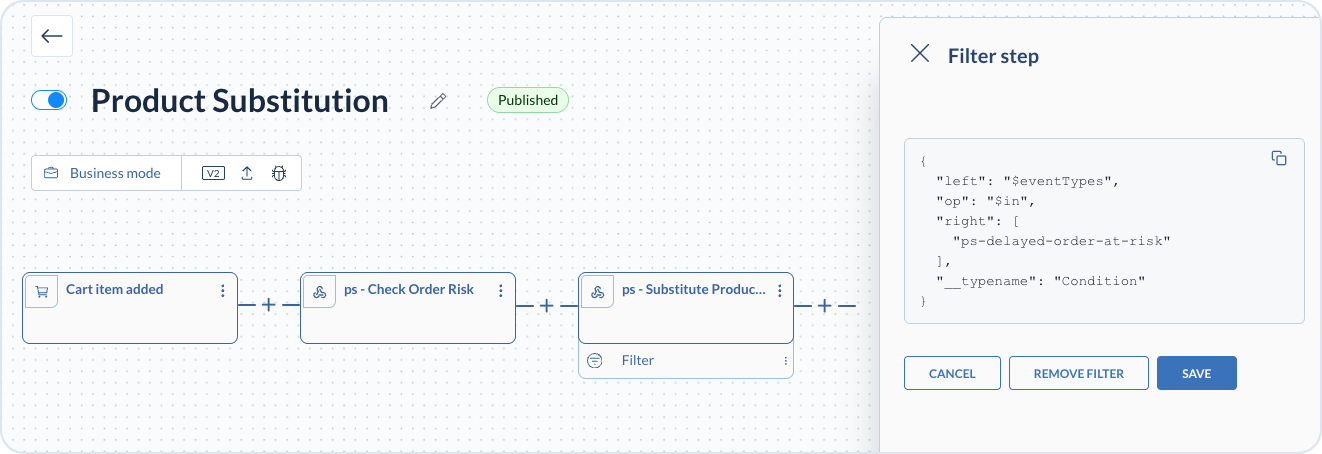
The process starts when a customer adds an item to a cart. The system automatically tracks the availability of the added item and, in case of any issues, it reacts immediately. It checks delay or cancellation risk, looks up configured substitutes, and triggers a storefront notification that offers alternative products so the buyer can keep processing with the order.

<figure><img src="/files/f34tjvFQTC9q4oVH55SN" alt="Product substitution steps"><figcaption><p>Product substitution steps</p></figcaption></figure>

### Risk detection

For each added item, the process checks quantity and evaluates a risk profile for that specific product and quantity combination. Risk intelligence can come from integrated external systems and operational data sources. If the risk score indicates likely delay or cancellation, the process moves to substitution handling.

### Substitution lookup

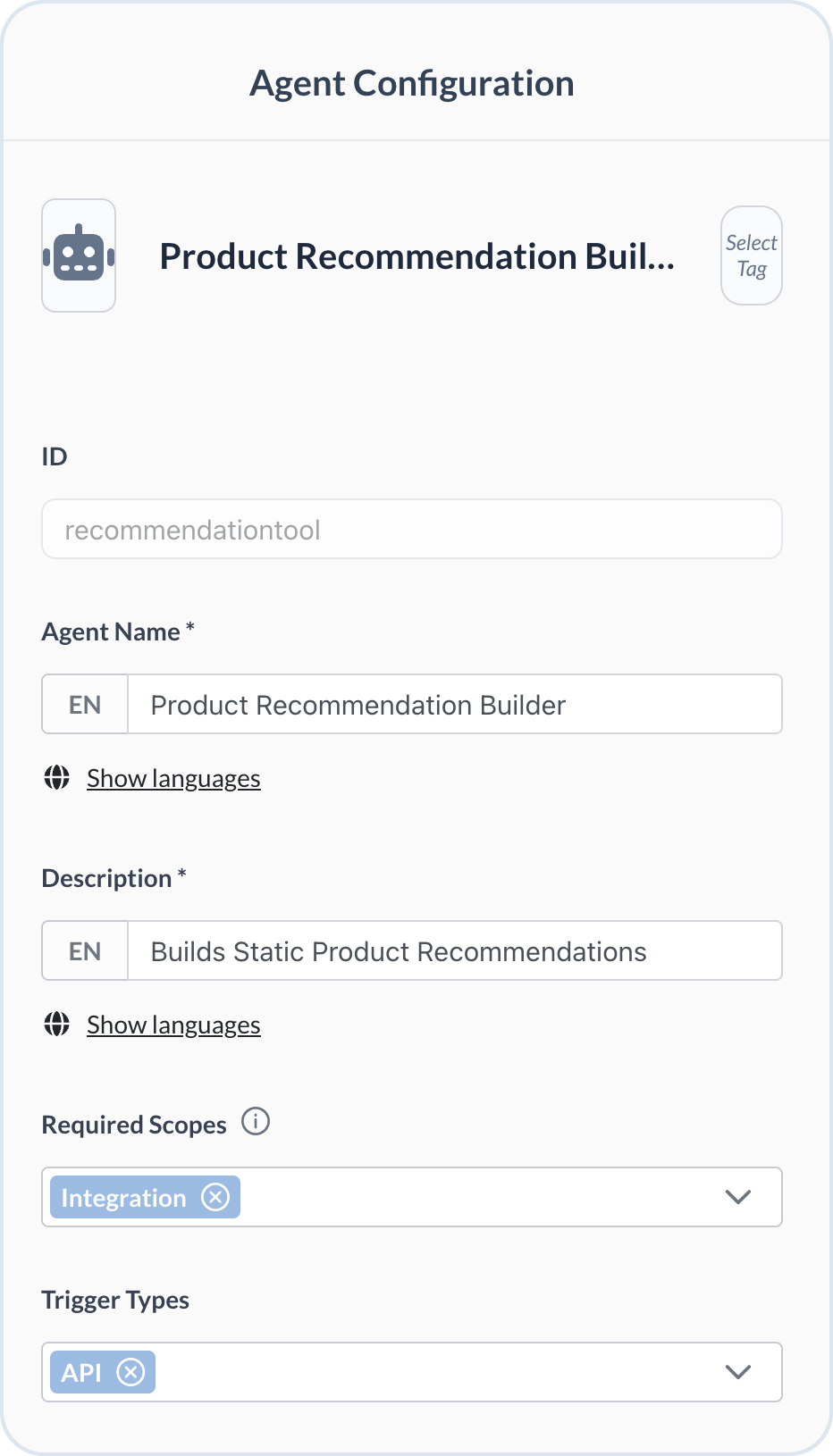
When high risk is detected, the process checks the product database for valid alternatives. The returned alternatives can include core product details such as identifier, name, image, and product link so they can be presented directly in the storefront. The solution can also use AI support to identify similar in-stock products and improve recommendation quality. To enable AI support, add the substitution agent either as a value stream step or as a Make scenario. A prerequisite is to create a related item type called `Similar`, which is used to determine substitutes.

<figure><img src="/files/2rP8YK2qw3nXR84gKtSz" alt="Product substitution AI agent" width="420"><figcaption><p>Product substitution AI agent</p></figcaption></figure>

### Customer notifications

When valid substitutes are available, the process creates a notification record that includes the original product and recommended alternatives, enabling the buyer to switch products. Depending on the configuration, based on these records can be displayed on the storefront as notifications for the buyers, for example in the cart or at checkout. The buyer can decide directly on the suggested products and continue with placing the order.

{% hint style="info" %}
The process is project-specific and not yet available as a standard integrated flow in the B2B Commerce Frontend.
{% endhint %}


---

# Agent Instructions: Querying This Documentation

If you need additional information that is not directly available in this page, you can query the documentation dynamically by asking a question.

Perform an HTTP GET request on the current page URL with the `ask` query parameter:

```
GET https://developer.emporix.io/partner-library/emporix-components/product-substitution.md?ask=<question>
```

The question should be specific, self-contained, and written in natural language.
The response will contain a direct answer to the question and relevant excerpts and sources from the documentation.

Use this mechanism when the answer is not explicitly present in the current page, you need clarification or additional context, or you want to retrieve related documentation sections.